

Hey hey, a warm welcome back! The year is slowly ending, which makes it the perfect time to start the Yearly Reflection. I’ve updated it based on the feedback I received last year.
Apart from that, you may notice that this post is a bit different than usual (or you will, in a moment). I felt like I was “writing myself into a corner” with Mental Garden, which limited the things I could write about. As an experiment, I want to open it up to a wider variety of topics and see how that feels.
Let’s start with a super random post about My Favorite Salad. Enjoy!
With gratitude
– Marc 🌱
My dear friends,
Do you know those ingredients that make people say, “Woah, this person can cook!”? Like when you add lemon zest to a dish and it suddenly tastes really premium, or when you use freshly ground pepper instead of powder? I’ve meticulously collected and tested such ingredients, and the result is a dish I call My Favorite Salad.
Now, I have a confession to make. It’s no longer just “my favorite,” I’ve become addicted to it. When I prepare it, I cut each individual ingredient in absolute slowest motion to delay my satisfaction. And, my friends, it is good.
I should probably be embarrassed about being so excited about the salad (you’ve been making fun of me). The first step is admitting you have a problem; the second is convincing everyone else they also have it. In this letter, I’ll share the exact recipe for you to try yourself, including the premium ingredients I tested that turned my innocent salad-eating habit into an addiction.
Default Meals
That innocent habit is what I call default meals.
Default meals are what you eat when you don’t know what to eat. They’re the easy and fast meals with a decent taste; the meals you make when you want to “fix hunger”. In the past, my default meals were plain oats with milk, pasta with pesto, bread, and German “Eintopf” (soup).
These meals were “good enough” in the dimensions that matter to me:
How healthy they are
How much of it there is (portion size and satiety)
How expensive they are
How much time and effort you need for preparation and cleanup
How much you enjoy it (taste, appearance, variety, novelty)
Every meal ticks some boxes, but usually you cannot tick them all. For example, fast food is high enjoyment and little effort, but ultimately unhealthy. Soup is relatively healthy, but often lower in enjoyment. Ordering something tasty and healthy is frequently expensive and not enough.1
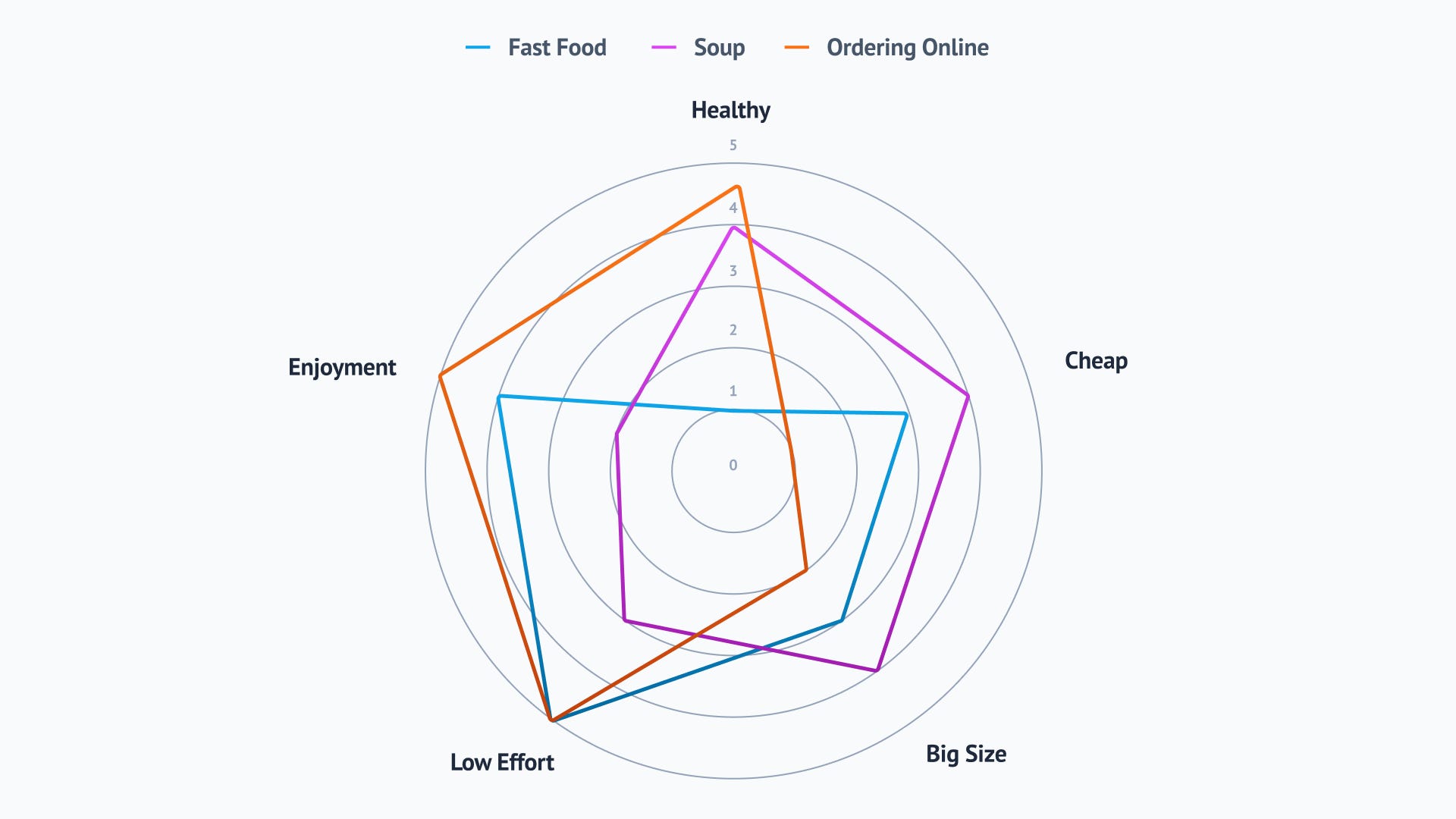
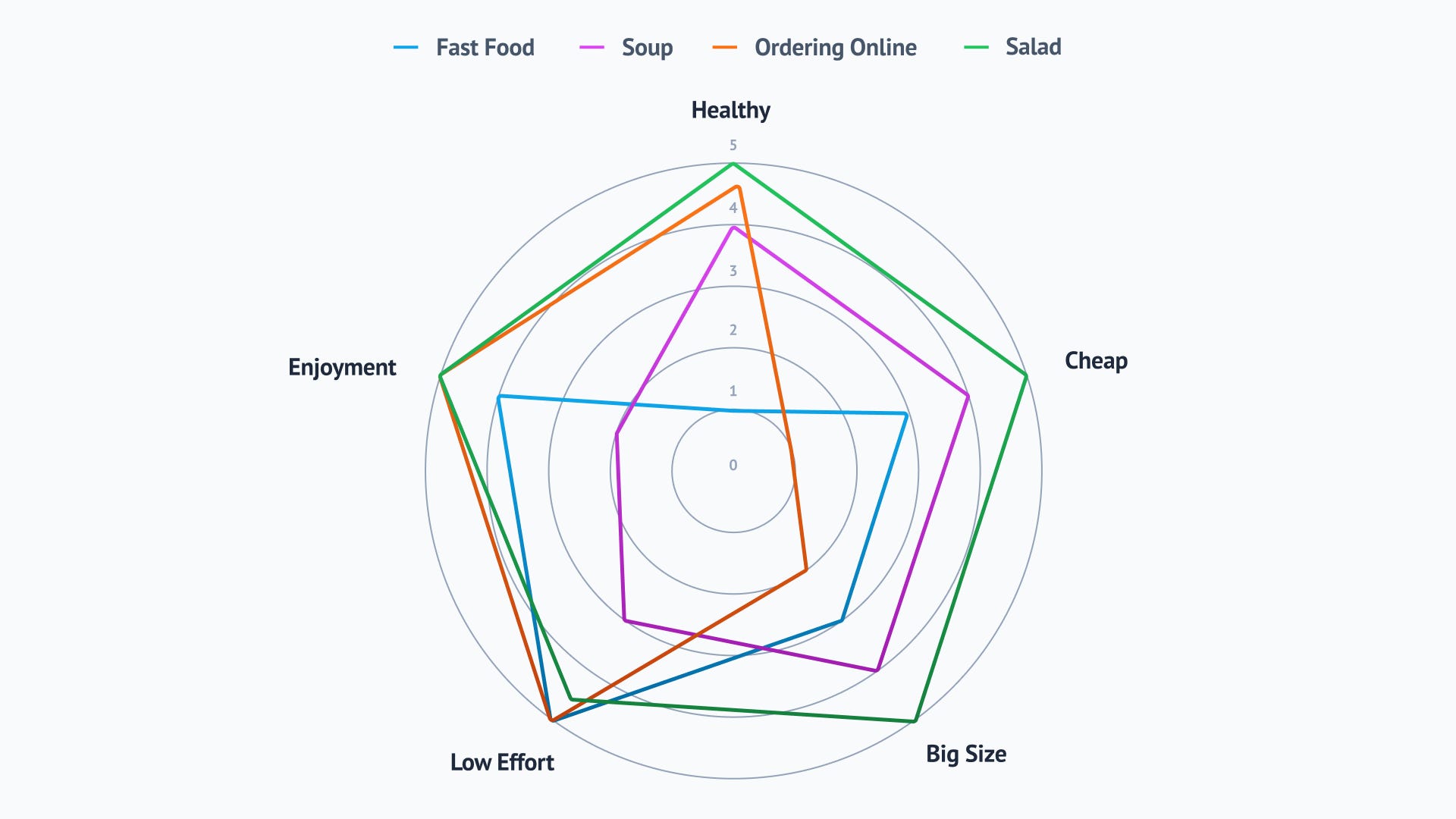
My goal is to max out all the dimensions of the ideal meal: healthy, cheap, filling, low effort and highly enjoyable. Since that’s rather difficult, I’ve ordered the preferences by importance: healthiness and portion size/satiety are non-negotiable; cheapness and effort are quite important; and tastiness is optional.
For most meals, I don’t care about having the best experience ever. I’d rather have a lot of something healthy and quick that tastes mediocre than something delicious that’s unhealthy. I just don’t want to feel hungry anymore. If that sounds outrageous (”Food is meant to be enjoyed!”), then why are so many of you scrolling through your phones while eating? Doesn’t sound like actively enjoying food either.
I don’t need to enjoy every meal. But that doesn’t mean I’m contra enjoyment; quite the opposite. That’s precisely why I’m obsessed with My Favorite Salad. It ticks all the boxes.
The Base Salad
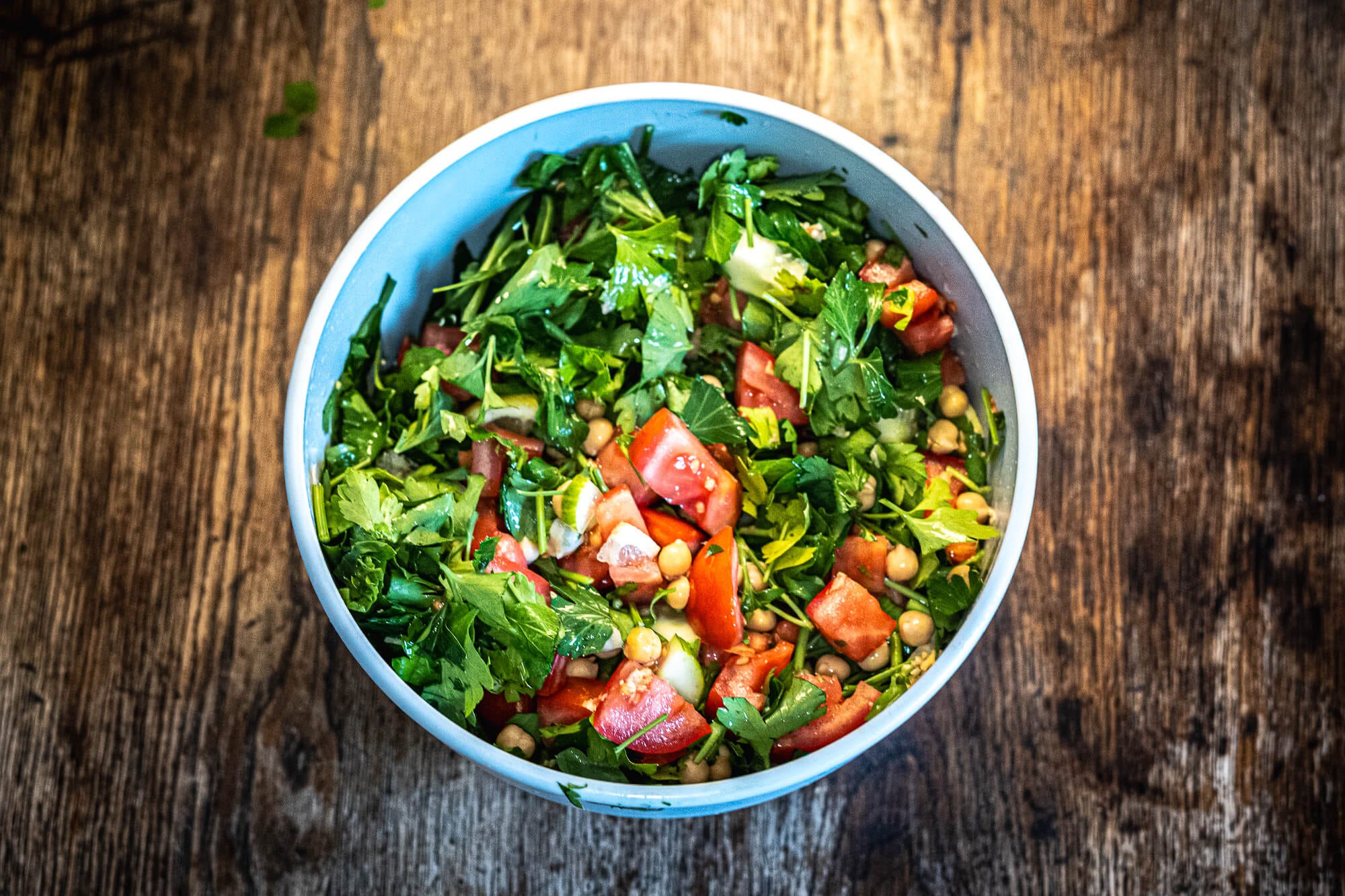
This salad is healthy (mostly greens), inexpensive and filling (~5€ per portion), and easy and fast to make (some cutting, mixing, and minor cleanup).
And it’s tasty!
To make a full meal (that’s a full bowl of salad), you need:
1 can of chickpeas (equivalent to ~120g of dried chickpeas)
1 cucumber
400-700g tomatoes (~3-5 big ones)
Extra-virgin olive oil
Soy sauce (gluten-free, if possible)
[See the Appendix for some variations.]
And that’s... not yet My Favorite Salad. We have to upgrade it first.
Minor Upgrades
To make the base salad much tastier, add one or two Minor Upgrades. They have a great cost-benefit ratio, adding a lot of enjoyment for each Euro and minute spent:
Leafy greens (e.g., lettuce, spinach, arugula)
Mozzarella
Olives
Dried tomato
Avocado
Canned fish2
Herbs of Provence
While these ingredients improve the salad, they won’t make you go “mhmm.” For that, you need the Premium Upgrades.
✨ Premium Upgrades ✨
Every ingredient in this section makes the salad much, much better. They are easy to prepare, healthy, affordable, and delicious, turning a boring base salad into a (literally) mouthwatering meal. Use one or two per salad.
You may laugh at these extraordinary claims, my friends. But wait until you’ve tried them! In ascending order of premiumness, here are the upgrades.
1. Onion ⭐️
Onions can be thinly sliced and/or briefly stir-fried.
Adding them raw in super-thin slices adds a sharp bite that contrasts with the mild flavor of the tomatoes. Because they’re so thin, their intensity stays tempered, giving just a hint of heat without overwhelming you.
Stir-frying them caramelizes the onion’s sugars, creating sweetness and umami and adding a savory dimension to the salad while blending into the background.
2. Garlic ⭐️⭐️⭐️
Garlic dramatically elevates the salad by adding a sharp, slightly spicy flavor. Small pieces create tiny bursts of intensity, while finely mincing or rubbing it into the dressing blends it smoothly into every bite. No matter how you use it, garlic will make your salad taste and smell vibrant and savory.
For a gentle start, mince 2 or 3 cloves through a crusher. If you don’t have a garlic press, grate the cloves instead. Personally, I like adding the garlic to the dressing so the oil spreads its flavor.
3. Flat Leaf Parsley ⭐️⭐️
As a replacement for other leafy greens, flat leaf parsley adds a bright, fresh, peppery flavor. With its rich green color, fresh scent, and subtle chew, it makes the salad feel crisp and alive.
Flat leaf parsley has a more satisfying texture and intense taste compared to the curly leaf variant. Add fresh mint or coriander to give the salad a subtly exotic flavor.
4. Ginger ⭐️⭐️
With its aromatic spiciness, ginger adds a lively heat that contrasts with sweet or mild vegetables. Its fresh, sharp scent raises the salad’s overall sensory complexity.
After washing the ginger, cut it into tiny pieces. If you don’t enjoy cutting ginger, grate it into the dressing (similar to the garlic). To complete the composition, add a bit of chili for some real spice.
Ginger pairs well with flat leaf parsley, so make sure to add them together.
5. Chicken ⭐️
Since chicken is mild on its own, it’s a strong carrier for whatever flavor you’re going for. Its neutrality works in your favor because it fills in flavor gaps in dishes that would otherwise taste bland.
When cooked well, chicken adds a firm, juicy chew that contrasts with crisp greens and soft vegetables. It gives your salad structural weight (literally something to bite into), which makes it feel more grounded and complete.
Chicken amplifies anything aromatic in your marinade. I usually marinate it with olive oil, soy sauce, garlic, and ginger, but I also like olive oil with curry paste.
6. Nuts and Seeds ⭐️⭐️
Nuts and seeds deliver a crisp, firm crunch that complements softer ingredients. Even a small sprinkle creates rhythm with each bite as you alternate between soft greens and sudden crispness. This contrast makes the salad feel more intentional and less monotonous.
When roasted, nuts and seeds bring warm, fragrant notes that lift the salad’s overall scent. Personally, I like adding roasted sunflower seeds or sesame seeds. My other favorite is roasted and salted peanuts for some added crunch.
7. Lemon Zest ⭐️
Subtle, yet effective, lemon zest adds a touch that makes people go “huh interesting.” Rather than penetrating everything with the sourness of lemon juice, lemon zest adds pure citrus oils that make an aromatic “pop”.
Take an organic lemon and grate some of the peel into the salad or dressing. Even a tiny amount shifts the entire scent profile, making it sparkly and bright. It pairs well with ginger, garlic, and soy sauce.
8. Lemon Slices ⭐️⭐️⭐️
Instead of grating the peel, try adding some slices with the peel. Cut three slices off a lemon. Then, slice those into smaller pieces, 2x2cm, and add them to the salad.
Using the whole slice instead of just the juice or zest adds three layers at once: juice, pith, and peel. The peel gives aromatic oils, the pith adds controlled bitterness, and the flesh burns with bright acidity. Biting into a slice of lemon brings these elements together all at once, which is why it feels like a sudden burst of intensity.
Adding lemon with the peel may sound strange at first because it’s unlike anything you’ve had before. However, it creates an interesting effect in your mouth. The intensity rapidly changes from soft to piercing to bitter and aromatic like a small explosion, leaving you in a surprised, satisfied state.
This is why lemon slices turned my original salad-eating habit into an addiction. The dopamine hits were just too much.
My Favorite Salad
This is My Favorite Salad. You eat it, put it into the mouth – noice.
Fundamentally, this salad is a choose your own adventure meal, flexible enough to allow you to experiment. Currently, I’m drawn to the following combination as my default meal:
Chickpeas
Cucumber
Tomato
Flat leaf parsley
Lemon slices
And for the dressing, which I then mix and pour over the salad:
Olive oil
Soy sauce
Grated ginger
Garlic
Hand-ground pepper
A touch of lemon juice.
Healthy, filling, inexpensive, easy, and quick to make. Overwhelmingly tasty. Can you see why I’m so excited about it? My dear friends, give this salad a try. It’s worth it.
Maybe it will become Your Favorite Salad, too.
With love,
Marc
P.S. Be careful when adding lemon slices. I wasn’t exaggerating when I said they’re addictive.
Appendix: Variations of the Base Salad
You can replace the chickpeas with other legumes, such as beans or lentils. I really like red beans.
I usually buy the bigger and cheaper tomatoes, even though they don’t taste as good. To compensate, I add a few smaller, tastier and more expensive tomatoes.
The dressing made with olive oil and soy sauce is surprisingly tasty (the best, actually), but you can use whatever dressing you want. This is also the step where you can add various spices. If I’m only going for the base without any upgrades, I usually add freshly ground pepper and herbs of Provence to improve the taste.
A few base ingredients that change the taste and variety of greens but don’t necessarily upgrade it are:
Carrots (ideally grated)
Beetroot (grated)
Bell pepper
Mushrooms (Agaricus bisporus. Upgrade them by stir-frying them first)
A friend commented that restaurants frequently use cheap, low-quality ingredients, making the resulting dish potentially/probably unhealthy, too. Apart from that, “healthiness” is something many people have their own definition of. Maybe a more accurate term is “micronutrient count”. With this definition, a meal can also have a negative health value. Take a cookie, for example, where the flour doesn’t contain any micros (too processed), but the body then needs certain micros to break it up. This means your body needs to use micros from the body, resulting in a negative micronutrient count. Thanks, Jonathan.
Specifically, get small fish like mackerel or sardines. Because they’re small and have a shorter lifespan, they have fewer toxins. Avoid tuna for that reason.